

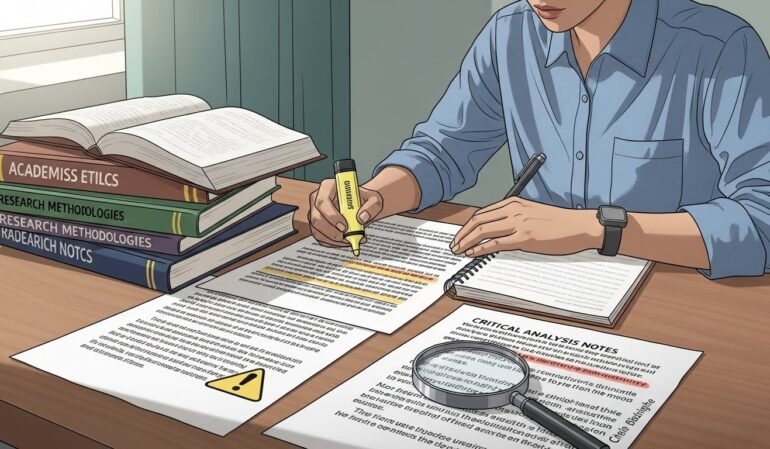
Opening a research paper can feel like trying to read another language. There may be unfamiliar terms, long paragraphs, complex methods, charts, and dozens of citations. The good news is that you do not need to understand every sentence on your first read.
A better approach is to read with a purpose.
The three-pass method helps students move from a quick overview to a deeper understanding without wasting time. Instead of treating every paragraph as equally important, you learn to identify the research question, evaluate the evidence, understand the method, and decide what the findings actually mean.
This guide explains how the method works, when to use it, what to write down, and which common reading mistakes to avoid.
What Is the Three-Pass Method?
The three-pass method is a structured way to read academic research.
Instead of trying to understand everything immediately, you read the paper three times. Each pass has a different purpose:
- Pass one: Understand what the paper is about.
- Pass two: Understand how the research was conducted.
- Pass three: Evaluate the argument, evidence, and limitations.
This approach is useful for college assignments, literature reviews, research projects, and class discussions.
It also prevents a common problem: spending 30 minutes on the first two pages and then rushing through the rest.
The goal is not simply to finish the paper. The goal is to understand enough to use the information correctly.
Pass One: Get the Big Picture
The first pass should be quick.
Do not highlight every sentence. Do not stop to look up every unfamiliar word. Instead, focus on the paper’s overall structure and purpose.
A first pass may take around 5–15 minutes, depending on the length and complexity of the paper.
Start With the Title and Abstract
The title tells you the general subject.
The abstract usually provides a condensed version of the study, including its purpose, method, major findings, and conclusion.
Ask yourself:
- What problem is the paper studying?
- What question are the researchers trying to answer?
- What type of research did they conduct?
- What did they discover?
You do not need complete answers yet. You are building a mental map.
Check the Headings
Scan the major sections.
Research papers often follow a structure such as:
- Introduction
- Literature Review
- Methods
- Results
- Discussion
- Conclusion
The headings show you where important information is located.
For example, if you need to understand how participants were selected, you know to look closely at the Methods section later.
Read the Introduction and Conclusion
Read these sections more carefully than the rest during your first pass.
The introduction explains why the research matters. The conclusion usually explains what the researchers believe their findings mean.
At the end of the first pass, try to explain the paper in two or three sentences.
If you cannot, go back to the abstract and introduction before moving on.
Pass Two: Understand the Research
The second pass is where you begin studying the paper more carefully.
Now you want to understand how the researchers reached their conclusions.
This is especially important because a strong-looking conclusion does not automatically mean the research is strong.
Examine the Research Question
Find the main research question or hypothesis.
For example:
Does sleep duration affect academic performance among college students?
Once you identify the question, the rest of the paper becomes easier to follow.
You can connect the method, results, and conclusion back to that central question.
Study the Method
The Methods section deserves close attention.
Look for details such as:
- Number of participants
- Participant characteristics
- Data collection process
- Research setting
- Variables being measured
- Research instruments
- Statistical methods
- Study duration
Consider a simple example.
Suppose a study claims that students who exercise more receive higher grades. You should ask how the researchers measured exercise and academic performance.
Did they track exercise objectively?
Did students simply report their own exercise habits?
Were grades measured using official academic records or self-reported estimates?
These details can change how much confidence you should place in the findings.
Read the Results Carefully
The Results section tells you what the researchers found.
Try not to interpret the findings too early.
Separate these two questions:
What happened?
and
What does it mean?
The first question belongs mainly to the Results section.
The second becomes more important in the Discussion.
Pay attention to tables, graphs, percentages, sample sizes, and statistical findings when they are provided.
You do not always need to understand every statistical formula. However, you should understand what the reported results are intended to show.
Pass Three: Analyze and Evaluate
The third pass turns reading into critical thinking.
Now you are asking whether the research is convincing, useful, and relevant.
This is especially valuable when writing an argumentative essay, research paper, or literature review.
Evaluate the Evidence
Ask:
- Does the evidence support the main claim?
- Is the sample large or appropriate enough?
- Are there obvious limitations?
- Could another explanation account for the results?
- Does the conclusion go beyond what the data actually shows?
For example, a study involving 50 students at one university may provide useful evidence, but its findings may not automatically apply to every college student in the United States.
Understanding this distinction is a major part of academic reading.
Look for Limitations
Most credible research has limitations.
A limitation does not necessarily make a study useless. Instead, it tells readers where the findings should be interpreted carefully.
Common limitations include:
- Small sample size
- Short study duration
- Self-reported information
- Limited geographic area
- Lack of a control group
- Possible researcher bias
- Correlation without proof of causation
A strong student does not simply repeat the author’s conclusion. They understand the conditions behind it.
Compare the Claims With the Evidence
One of the most useful questions you can ask is:
Does the evidence actually justify the claim?
Imagine researchers discover that students who sleep more tend to have higher GPAs.
That finding may show a relationship between sleep and grades.
It does not necessarily prove that sleeping longer directly causes higher grades.
Other factors could be involved, such as stress, workload, health, employment, or study habits.
This distinction between correlation and causation is important across many academic subjects.
What to Take Notes On
Good notes should make it easier to remember and use the paper later.
You do not need to copy large sections of text.
Instead, create a simple research note containing:
1. Research Question
What problem is the paper trying to answer?
2. Main Argument
What is the central claim?
3. Method
How was the research conducted?
4. Key Findings
What are the most important results?
5. Evidence
What evidence supports the findings?
6. Limitations
What weaknesses or restrictions should readers know?
7. Useful Ideas
Which concepts could help with your own assignment or research?
A simple note-taking format might look like this:
Research question: Does sleep affect student performance?
Method: Survey of college students.
Main finding: Students reporting longer sleep generally reported better academic performance.
Limitation: The study relied on self-reported data.
Useful point: Sleep may be associated with academic outcomes, but the findings do not necessarily prove causation.
This is much more useful than highlighting half the paper.
How to Handle Difficult Research Papers
Some papers will still be difficult even after using the three-pass method.
That is normal.
Academic papers often contain technical vocabulary, theories, statistical concepts, or background information that you have not studied before.
Do Not Look Up Every Unknown Word
If you stop for every unfamiliar term, reading becomes painfully slow.
Instead, mark unfamiliar concepts and keep reading.
After you understand the paragraph or section, return to the terms that still matter.
Context often makes difficult terminology easier to understand.
Use the References
If the paper repeatedly mentions a theory or previous study that you do not understand, check the cited source or find a reliable academic explanation.
The reference list can also reveal the research tradition behind the paper.
For example, if several important claims depend on the same earlier study, that study may be worth examining directly.
Break Long Papers Into Sessions
A 30-page research paper does not always need to be read in one sitting.
Try dividing it into sections:
Session 1: Abstract and Introduction
Session 2: Literature Review and Methods
Session 3: Results
Session 4: Discussion and Conclusion
This can reduce mental fatigue and improve comprehension.
A Simple Research Paper Reading Example
Imagine you are assigned a paper about social media and college student concentration.
During the first pass, you discover that the researchers are studying whether frequent social media use is associated with reduced concentration.
During the second pass, you discover that they surveyed 400 college students about their social media habits and concentration levels.
During the third pass, you notice that the study is based on self-reported behavior.
That detail matters.
Students may not accurately remember how much time they spend on social media. The researchers may have found a relationship, but the study may not prove that social media directly causes concentration problems.
Your final notes could therefore say:
The study found an association between social media use and concentration, but its reliance on self-reported data limits how strongly the results can be interpreted.
That is a much stronger academic understanding than simply writing, “Social media reduces concentration.”
When You Need Help With Academic Writing
Reading research is only one part of academic work.
Students also have to turn what they learn into clear arguments, properly organized paragraphs, citations, and complete assignments.
When you understand the research but struggle to organize your ideas, reviewing examples of a custom essay writing service can help you see how academic arguments, evidence, and structure can be presented clearly.
The important point is to use outside resources responsibly. Academic work should reflect your own understanding, follow your school’s policies, and properly acknowledge sources.
Common Mistakes Students Make
Reading Every Paper From Beginning to End
Not every paper deserves the same amount of reading time.
Start with the abstract, introduction, headings, figures, and conclusion before deciding where deeper reading is needed.
Highlighting Too Much
If almost every sentence is highlighted, nothing stands out.
Highlight only information that helps answer your research question.
Ignoring the Methods Section
Students sometimes focus heavily on findings and skip the methodology.
That is a mistake.
The method tells you how the evidence was produced.
Treating Every Published Study as Perfect
Publication does not mean a study has no limitations.
Academic research should be examined critically.
Confusing Opinion With Evidence
A discussion section may contain interpretation and broader implications.
Separate those interpretations from the actual findings.
Taking Notes Without Recording the Source
Always record enough citation information while reading.
Depending on your assignment, this may include:
- Author names
- Publication year
- Article title
- Journal name
- Volume and issue
- Page numbers
- DOI or database information
Doing this early can save a lot of time later.
Best Practices for Better Academic Reading
Use these habits consistently:
- Know your purpose before reading.
Are you looking for evidence, background information, a theory, or a research method? - Preview before reading deeply.
Learn the paper’s structure first. - Read actively.
Ask questions instead of simply moving your eyes across the page. - Connect evidence to claims.
Always ask what supports the author’s conclusion. - Separate findings from interpretation.
What the researchers found is not always identical to what they believe it means. - Write notes in your own words.
This improves understanding and reduces accidental copying. - Record sources immediately.
Do not leave citation details until the night before your assignment is due. - Explain the paper without looking at it.
If you can describe the research clearly from memory, you probably understand it.
FAQs
How long should it take to read a research paper?
It depends on the paper’s length and complexity. A short paper may take 30–60 minutes, while a technical paper can require several hours and multiple reading sessions.
What should I read first in a research paper?
Start with the title, abstract, headings, introduction, and conclusion. Then decide which sections require the closest reading.
Should I read the abstract or conclusion first?
Both can be useful. The abstract gives you a quick overview, while the conclusion helps you understand the authors’ final interpretation.
How do I know if a research paper is credible?
Look at the authors, publication venue, research methods, evidence, citations, limitations, and whether the claims are supported by the data.
Should I highlight a research paper?
Yes, but selectively. Highlight key claims, evidence, definitions, findings, and information directly related to your research question.
What is the hardest part of reading academic research?
For many students, the hardest part is connecting the research question, methodology, evidence, and conclusion. A structured reading method makes those connections easier to see.
Can I use research papers in an essay?
Yes. Research papers can provide evidence, background, expert perspectives, and opposing viewpoints. Make sure you cite them according to the required academic style.
What is the three-pass method?
It is a structured reading approach in which the first pass identifies the paper’s main idea, the second examines its research and evidence, and the third evaluates its strengths, limitations, and conclusions.
Conclusion
Reading a research paper does not have to mean understanding every sentence on the first attempt.
The three-pass method gives you a better process. First, understand the big picture. Next, examine the research methods and evidence. Finally, evaluate the argument, limitations, and conclusions.
The biggest improvement comes from changing the question you ask while reading.
Instead of asking, “What does this paragraph say?”, ask:
“Why does this information matter to the research question?”
That small change turns passive reading into active academic analysis.
With practice, you will spend less time rereading difficult papers and become much better at identifying useful evidence for essays, presentations, literature reviews, and research projects.