

Play-Based Learning in Nagpur’s Preschool: How Everyday Activities Build Essential Skills in Children
Early childhood is an important stage when children begin discovering the world around them. During these formative years, everyday experiences help shape their communication, thinking abilities, creativity, social behaviour, and independence. One effective approach to supporting this development is learning through play.
Play-Based Learning in Nagpur’s Preschool provides children with opportunities to explore ideas, interact with others, experiment with different materials, and develop useful abilities through enjoyable activities. Instead of depending only on formal instruction, this approach allows young learners to understand concepts through practical experiences.
For parents looking for a suitable preschool in Nagpur, understanding the value of play-based education can help them make informed decisions about their child’s early learning journey.
What Is Play-Based Learning in Preschool?
Play-based learning is an educational approach in which children develop knowledge and skills through games, creative tasks, exploration, storytelling, and group experiences. Play-Based Learning in Nagpur’s Preschool
In this method, play is not simply a way to keep children entertained. Activities are planned to encourage curiosity, support development, and introduce age-appropriate learning concepts.
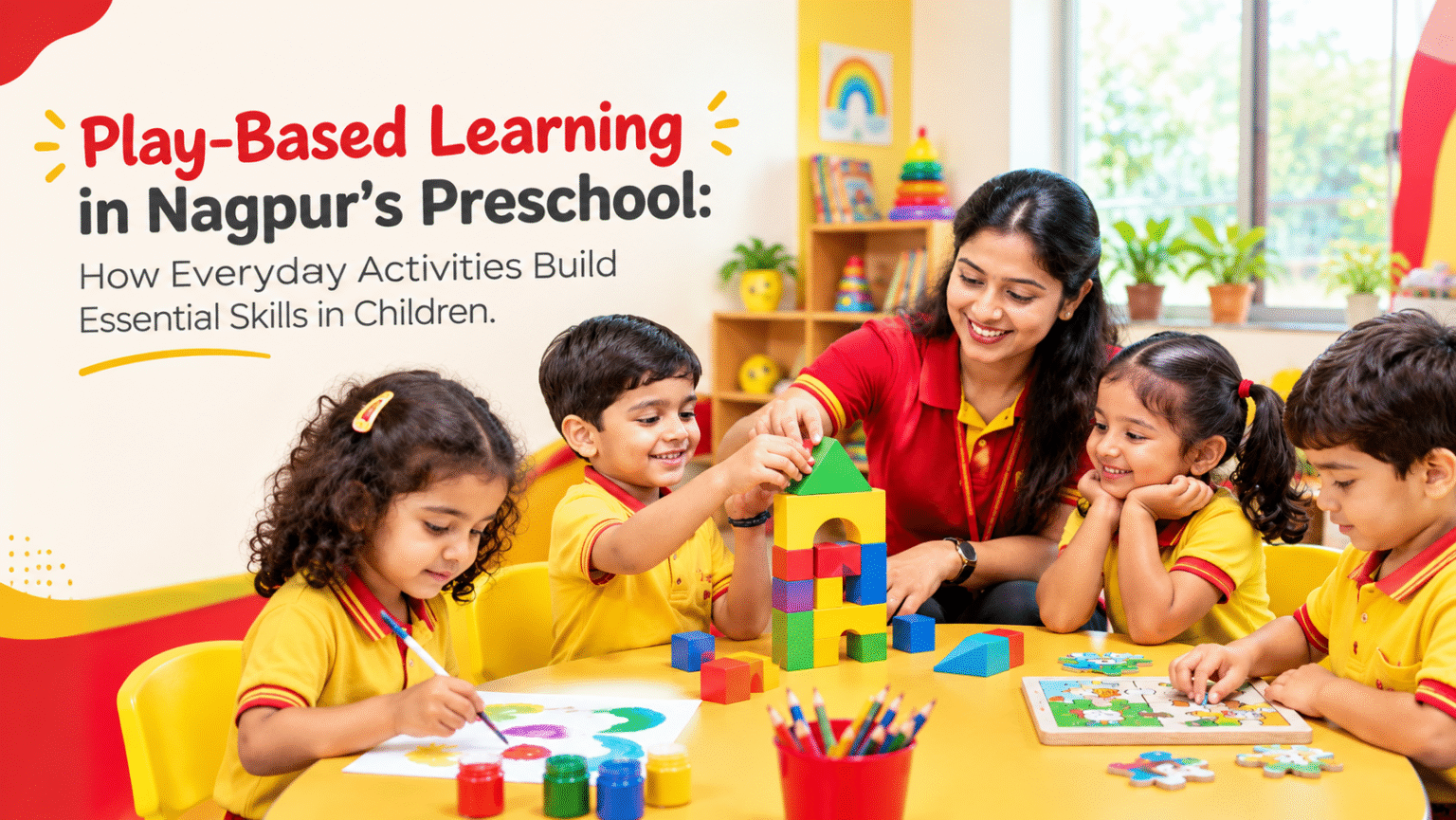
For example, building a tower with blocks can introduce children to shapes, sizes, balance, and problem-solving. Similarly, playing a pretend shopkeeper game can help them practise counting, speaking, listening, and taking turns.
Play-Based Learning in Nagpur’s Preschool combines enjoyment with meaningful learning experiences, helping children become active participants in their education.
Why Is Play-Based Learning Important for Young Children?
Young children naturally learn by observing, touching, asking questions, and trying new things. Play gives them a comfortable environment to explore their surroundings and understand how different things work.
Here are some important benefits of this learning approach. Play-Based Learning in Nagpur’s Preschool
1. Develops Communication and Language Skills
Children learn to express their thoughts and communicate with others through everyday conversations and interactive activities.
Storytelling, picture discussions, rhymes, role-play, and group games encourage children to listen carefully, learn new words, and form simple sentences.
For instance, during a pretend restaurant activity, children may take the roles of customers and servers. They practise asking questions, responding politely, and communicating their choices.
These experiences make Play-Based Learning in Nagpur’s Preschool a valuable way to encourage language development in a natural setting.
2. Encourages Creativity and Imagination
Creative activities give children the freedom to experiment with colours, materials, sounds, and ideas.
Drawing, painting, clay modelling, music, and pretend-play games encourage them to express themselves in different ways.
When children create their own artwork or imagine a story, they learn that there can be several ways to approach a task. Such experiences can strengthen imagination, creative thinking, and confidence.
3. Improves Social Interaction
Preschool provides opportunities for children to meet classmates, participate in group activities, and develop friendships.
Games that involve sharing, teamwork, and turn-taking teach children how to interact respectfully with others.
For example, when a group of children builds a structure using blocks, they may need to share materials, discuss their ideas, and work towards a common goal.
Through Play-Based Learning in Nagpur’s Preschool, children can practise cooperation, patience, and positive social behaviour.
4. Builds Problem-Solving and Thinking Abilities
Many play activities encourage children to observe situations, make decisions, and find solutions.
Puzzles, matching games, sorting objects, and construction activities introduce basic reasoning skills.
When a child tries to complete a puzzle, they examine different pieces, identify patterns, and test possible combinations. These small challenges encourage independent thinking and persistence.
5. Supports Physical and Motor Development
Physical activities are an important part of early childhood education. They help children develop coordination, balance, movement control, and body awareness. Play-Based Learning in Nagpur’s Preschool
Running, jumping, dancing, catching balls, and outdoor games support the development of larger muscle groups.
Activities such as colouring, threading beads, using child-safe scissors, and playing with clay help strengthen fine motor skills that are useful for everyday tasks.
6. Encourages Emotional Understanding
Children gradually learn to recognise their feelings and respond to different situations.
Puppet shows, storytelling, pretend play, and group discussions can help introduce emotions such as happiness, sadness, excitement, and frustration.
When children participate in these activities, they get opportunities to express themselves, understand others, and practise responding to different emotions.
Everyday Play-Based Activities That Support Learning
Children do not always need complicated resources to learn something valuable. Simple, thoughtfully planned activities can introduce several important concepts. Play-Based Learning in Nagpur’s Preschool
Here are some examples of activities that can support development in a preschool environment.
1. Building Blocks and Construction Games
Building blocks allow children to explore different shapes, sizes, patterns, and structures.
Teachers can encourage children to create towers, bridges, houses, or other imaginative designs. They can also introduce simple questions such as which block is bigger or how to make a tower more stable.
These activities combine creative exploration with early mathematical thinking.
2. Art, Painting, and Craft Activities
Art activities provide children with opportunities to experiment with colours, textures, and materials.
Finger painting, paper collage, colouring, and clay modelling allow young learners to create something using their own ideas.
These experiences also help children practise hand movements and develop greater control over small objects. Play-Based Learning in Nagpur’s Preschool
3. Storytelling and Puppet Shows
Stories introduce children to new words, characters, situations, and ideas. Puppet shows make storytelling more interactive and encourage children to participate.
Teachers can ask simple questions about the characters and events to help children remember details and express their thoughts.
4. Sorting and Matching Games
Sorting games encourage children to group objects according to their colours, sizes, shapes, or other similarities.
For example, children can separate red and yellow objects or match cards containing similar pictures. Play-Based Learning in Nagpur’s Preschool
These simple tasks introduce basic concepts of classification, comparison, and logical thinking.
5. Pretend Play and Role-Playing
Pretend play allows children to explore familiar situations through imagination.
They may act as doctors, teachers, shopkeepers, chefs, or family members. While playing these roles, they practise conversations, understand different responsibilities, and learn how people interact.
6. Music, Rhymes, and Movement Games
Music and movement activities bring together listening, physical coordination, and creative expression.
Singing rhymes, clapping to rhythms, dancing, and following simple movement instructions help children participate actively. Play-Based Learning in Nagpur’s Preschool
These activities can also make it easier for children to remember words and sequences.
7. Outdoor Games and Nature Exploration
Outdoor play gives children an opportunity to move freely, observe their surroundings, and explore nature.
Activities such as collecting leaves, identifying plants, playing with balls, and observing insects can encourage curiosity about the environment. Play-Based Learning in Nagpur’s Preschool
Outdoor experiences also introduce children to movement, teamwork, and basic environmental awareness.
How Teachers Support Play-Based Learning in Preschool
Teachers play an important role in making play activities meaningful and developmentally appropriate.
Their responsibility goes beyond arranging games. They observe children’s interests, introduce suitable activities, encourage participation, and provide support when needed.
Some important ways teachers can guide this process include:
- Planning purposeful activities: Selecting games that support age-appropriate learning goals.
- Encouraging exploration: Giving children opportunities to experiment and discover things independently.
- Supporting communication: Asking open-ended questions and encouraging children to share their ideas.
- Promoting cooperation: Organising activities that involve sharing, teamwork, and turn-taking.
- Observing progress: Noticing how children participate, communicate, and approach different challenges.
- Creating a welcoming environment: Making sure children feel comfortable expressing themselves and trying new activities. Play-Based Learning in Nagpur’s Preschool
A supportive classroom atmosphere helps children participate with greater confidence and enjoy their learning experiences.
How Parents Can Encourage Play-Based Learning at Home
Learning does not stop when children leave the preschool classroom. Parents can support their development by including simple learning opportunities in everyday family routines.
Here are some practical ideas:
- Read stories together: Ask children about the characters, pictures, and events in a story.
- Use household objects for learning: Introduce sorting, counting, and matching through safe everyday items.
- Encourage creative activities: Provide crayons, paper, and age-appropriate craft materials.
- Play simple games: Try puzzles, memory games, building blocks, and matching activities.
- Explore the outdoors: Observe plants, trees, birds, and other things in the surroundings.
- Allow independent play: Give children time to explore their own ideas without directing every activity.
- Appreciate their efforts: Encourage curiosity and participation rather than focusing only on the final result.
When parents and teachers encourage similar learning habits, children receive more opportunities to practise their developing skills. Play-Based Learning in Nagpur’s Preschool
How to Choose a Preschool That Encourages Learning Through Play in Nagpur
Choosing a preschool is an important decision for parents. Along with location and convenience, it is useful to understand how a school approaches early childhood education.
When visiting a preschool in Nagpur, consider the following points:
- Activity-based teaching: Ask whether children participate in creative, interactive, and hands-on activities.
- Classroom environment: Look for a welcoming, organised, and age-appropriate learning space.
- Teacher interaction: Observe how teachers communicate with children and encourage participation.
- Balanced daily routine: Understand how the schedule includes learning activities, playtime, movement, and rest.
- Social development: Ask how children are encouraged to share, cooperate, and interact with classmates.
- Parent communication: Find out how the preschool shares information about children’s participation and development. Play-Based Learning in Nagpur’s Preschool
A good preschool experience should support children’s curiosity, comfort, and overall development while respecting their individual learning pace.
Frequently Asked Questions
1. What is play-based learning in preschool?
Play-based learning is an educational approach in which children develop different skills through games, creative activities, storytelling, exploration, and interactive experiences.
2. Why is play-based learning important for preschool children?
It provides opportunities to develop communication, creativity, social interaction, problem-solving, physical coordination, and emotional understanding through enjoyable activities.
3. Which activities are useful for play-based learning?
Building blocks, painting, puzzles, storytelling, pretend play, music, sorting games, and outdoor exploration are examples of activities that support early learning.
4. Does play-based learning help children prepare for school?
Yes. Age-appropriate play activities can introduce early language, number, observation, communication, and cooperation skills that are useful when children move into formal schooling. Play-Based Learning in Nagpur’s Preschool
5. How can parents support play-based learning at home?
Parents can read stories, play simple games, encourage drawing, introduce safe sorting activities, explore nature, and provide opportunities for independent play.
6. How can I identify a preschool that follows play-based learning in Nagpur?
Ask about classroom activities, teacher-child interaction, daily routines, creative opportunities, and how the school supports children’s social, emotional, physical, and thinking skills.
Play is an important part of how young children explore their surroundings, develop relationships, and understand new ideas. From building blocks and storytelling to outdoor games and creative activities, everyday experiences can provide meaningful opportunities for learning.
Play-Based Learning in Nagpur’s Preschool gives children opportunities to develop essential abilities while enjoying their early educational experiences. With supportive teachers, engaging activities, and encouragement from parents, children can gradually build confidence, independence, creativity, and communication skills.
At Kids Umbrella Preschool, the early learning journey can be presented as an opportunity for children to explore, participate, create, and grow through meaningful everyday experiences. Play-Based Learning in Nagpur’s Preschool