How Preschool Prepares Children for Primary School
Starting primary school is an important milestone in a child’s life. For many parents, the transition from early childhood learning to formal schooling can bring questions such as: Is my child ready for primary school? What skills should they have? How can preschool help?
Preschool plays an important role in preparing children for this transition. It introduces children to structured routines, early academic concepts, communication, social interaction, and independent habits in an age-appropriate and enjoyable way.
Rather than focusing only on reading, writing, or numbers, a good preschool experience helps children develop the confidence, curiosity, social skills, and learning habits they need to adapt to primary school.
What Does School Readiness Mean?
School readiness does not mean that a child must already know everything taught in primary school. Instead, it refers to a combination of skills that help children participate comfortably and confidently in a classroom environment.
These may include:
- Listening and following simple instructions
- Communicating needs and ideas
- Interacting positively with other children
- Managing basic personal tasks
- Sitting and participating in activities
- Recognising basic letters, numbers, shapes, and colours
- Developing attention and concentration
- Managing emotions appropriately
- Showing curiosity and willingness to learn
Preschool provides children with opportunities to develop these abilities gradually through play, activities, conversations, stories, and classroom routines.
1. Preschool Introduces Children to Classroom Routines
One of the biggest changes when children enter primary school is the introduction of a more structured daily routine.
Preschool helps children gradually adjust to everyday classroom routines, including: :
- Arriving at school on time
- Greeting teachers and classmates
- Keeping belongings in their designated place
- Participating in group activities
- Following classroom instructions
- Cleaning up after activities
- Moving from one activity to another
These simple routines can make the transition to primary school more comfortable because children already understand the basic idea of following a daily schedule.
2. It Builds Early Literacy Skills
Children do not need advanced reading skills before entering primary school, but developing an interest in language and books can give them a strong foundation.
Preschool activities may introduce children to:
- Alphabet recognition
- Letter sounds
- Storytelling
- Picture books
- Rhymes and songs
- Vocabulary development
- Listening activities
- Pre-writing exercises
Storytelling and conversations are particularly valuable because they encourage children to listen, understand, express ideas, and learn new words.
These early experiences can make formal reading and writing instruction easier to approach later.
3. Preschool Develops Basic Mathematical Thinking
Early mathematics is not simply about memorising numbers. Children begin developing mathematical thinking through everyday activities and play.
For example, children may learn about:
- Counting
- Number recognition
- Shapes
- Colours
- Sorting
- Matching
- Patterns
- Comparing sizes
- Understanding more and less
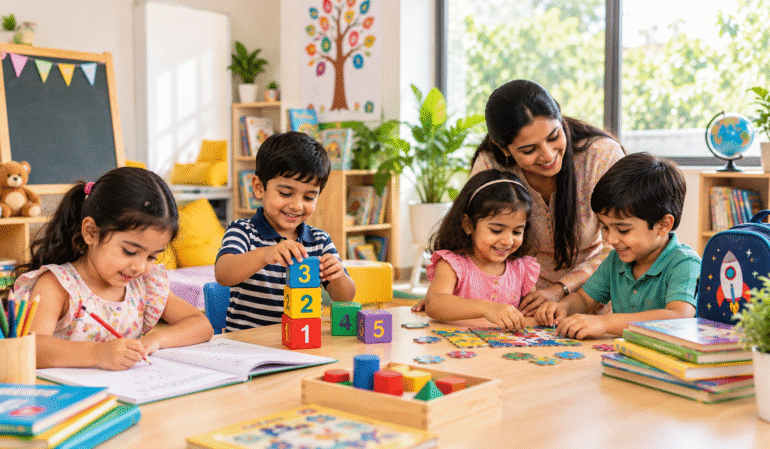
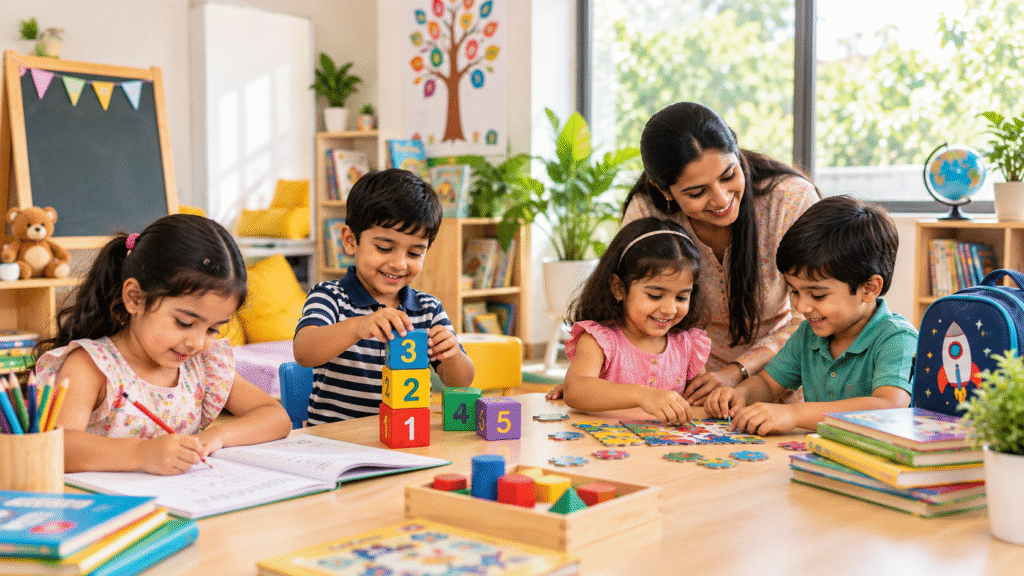
Building blocks, puzzles, counting games, and sorting activities can introduce mathematical concepts naturally while keeping learning enjoyable.
4. It Strengthens Communication Skills
Communication is essential when children enter primary school.
A child needs to be able to communicate with teachers and classmates, ask for help, answer questions, and express thoughts or feelings.
Preschool encourages communication through:
- Group discussions
- Storytelling
- Songs and rhymes
- Role-play
- Show-and-tell activities
- Teacher-child conversations
- Peer interaction
Regular opportunities to speak and listen can help children become more comfortable expressing themselves in a classroom.
5. Preschool Encourages Social Skills
Primary school involves spending significant amounts of time with other children. Preschool gives children an opportunity to practise social interaction before they enter a larger and more structured school environment.
Children learn important social behaviours such as:
- Sharing
- Taking turns
- Cooperating
- Waiting patiently
- Listening to others
- Making friends
- Working in groups
- Respecting classroom rules
These experiences help children understand how to participate positively in a group.
6. It Supports Emotional Development
Being academically prepared is only one part of school readiness. Children also need to develop emotional confidence.
Preschool provides opportunities for children to:
- Express their feelings
- Handle small frustrations
- Ask for help
- Try new activities
- Recover from mistakes
- Build confidence
- Become comfortable away from parents
Teachers can guide children through everyday situations and help them understand appropriate ways to respond to different emotions.
7. Preschool Builds Independence
Primary school requires children to manage several simple tasks independently.
Preschool gradually encourages children to take responsibility for age-appropriate activities such as:
- Carrying and organising their belongings
- Eating independently
- Washing their hands
- Putting away toys
- Using classroom materials carefully
- Following simple instructions
- Completing small tasks
Developing independence can help children feel more capable when they begin primary school.
8. It Improves Attention and Concentration
Primary school requires children to listen to teachers, participate in activities, and stay engaged for increasing periods of time.
Preschool activities can gradually develop attention through:
- Puzzles
- Drawing and colouring
- Story sessions
- Building activities
- Matching games
- Music and movement
- Simple worksheets
- Group activities
The goal is not to expect young children to sit still for long periods. Instead, preschool provides age-appropriate opportunities to gradually strengthen their ability to focus.
9. Preschool Develops Fine Motor Skills
Writing is an important part of primary education, and children need adequate hand and finger control to use pencils comfortably.
Preschool activities such as:
- Drawing
- Colouring
- Clay modelling
- Cutting and pasting
- Bead activities
- Tracing
- Building with blocks
can help strengthen fine motor coordination.
These activities prepare children for tasks that require controlled hand movements, including writing and using classroom materials.
10. It Encourages Problem-Solving and Critical Thinking
Primary school learning involves more than memorising information. Children are encouraged to think, ask questions, make connections, and solve simple problems.
Preschool can support these abilities through open-ended activities and play.
For example, a teacher might ask:
“How can we make this tower taller without letting it fall?”
Instead of simply giving children the answer, the activity encourages them to experiment, observe, make decisions, and try again.
This kind of learning develops curiosity and problem-solving habits.
11. Preschool Makes Learning Enjoyable
A positive early learning experience can influence how children feel about education.
Play-based learning allows children to explore concepts through activities that are interesting and meaningful to them. Songs, stories, art, games, movement, and hands-on activities can make learning feel enjoyable rather than stressful.
When children associate learning with curiosity and discovery, they may approach new experiences with greater confidence.
12. It Helps Children Adjust to a New Environment
For some children, entering primary school can be challenging because they are suddenly introduced to a new environment, new teachers, new classmates, and new expectations.
Preschool gives children an earlier opportunity to experience a school setting.
They gradually learn that:
- Parents may leave and return later
- Teachers are available to support them
- Classmates can become friends
- Classroom rules help everyone learn
- New activities can be exciting
- Asking for help is okay
This familiarity can make the transition to primary school smoother.
Preschool and Primary School: Building a Continuous Learning Journey
Preschool should not be viewed as a smaller version of primary school. Its purpose is to provide children with developmentally appropriate experiences that prepare them for future learning.
While primary school generally places greater emphasis on formal academics, preschool focuses on developing the foundations that support those academics.
| Preschool Focus | How It Helps in Primary School |
| Storytelling | Supports language and comprehension |
| Counting games | Builds early mathematical understanding |
| Group activities | Develops cooperation |
| Drawing and colouring | Strengthens fine motor skills |
| Classroom routines | Builds familiarity with school structure |
| Role-play | Encourages communication |
| Puzzles | Develops problem-solving |
| Independent tasks | Builds confidence and responsibility |
How Parents Can Support School Readiness at Home
Preschool is only one part of preparing a child for primary school. Parents can reinforce these skills through simple everyday activities.
Try to:
- Read stories together regularly.
- Encourage your child to talk about their day.
- Give them small age-appropriate responsibilities.
- Practise counting during everyday activities.
- Encourage drawing, colouring, and creative play.
- Teach them to organise their belongings.
- Give them opportunities to play with other children.
- Establish consistent sleep and morning routines.
- Encourage them to ask questions.
- Praise effort rather than focusing only on correct answers.
Most importantly, avoid putting unnecessary academic pressure on young children. School readiness develops gradually, and every child progresses at their own pace.
Frequently Asked Questions
Is preschool necessary before primary school?
Preschool can provide valuable preparation for primary school by helping children develop communication, social, emotional, cognitive, motor, and independence skills. However, children develop differently, and families should consider their individual circumstances and the expectations of the primary school they plan to attend.
What should a child know before starting primary school?
A child does not need to master the entire primary-school curriculum beforehand. Basic communication, listening, social interaction, independence, early literacy and numeracy awareness, and the ability to participate in simple routines are generally more useful foundations.
Does preschool teach reading and writing?
Many preschools introduce early literacy through stories, rhymes, alphabet activities, drawing, tracing, and other age-appropriate experiences. The level of formal reading and writing instruction varies between schools.
How does preschool help children become independent?
Children are gradually encouraged to manage simple tasks such as organising belongings, cleaning up after activities, following routines, and completing age-appropriate tasks. These experiences can build confidence and responsibility.
Preschool prepares children for primary school by building the foundations they need to learn, communicate, participate, and become more independent. From classroom routines and early literacy to social skills, emotional confidence, problem-solving, and fine motor development, these experiences help children approach their next educational stage with greater familiarity and confidence.
The goal of preschool is not to make children academically advanced before primary school. It is to help them become curious, confident, capable, and ready to learn.
For parents, choosing a preschool that provides a safe, nurturing, engaging, and age-appropriate learning environment can be an important step in supporting a child’s transition to primary education.