Preschool Education vs. Home Learning – What’s Best for Your Child?
Every parent hopes to give their child the strongest possible start on their learning journey.. In recent years, the debate between preschool education and home learning has become more important than ever. While preschools promise structured development and social interaction, home learning offers flexibility and personal attention. But which one truly prepares your child for lifelong success?
Let’s explore the pros, cons, and key differences between these two early learning approaches to help you make the right choice.
Understanding Preschool Education
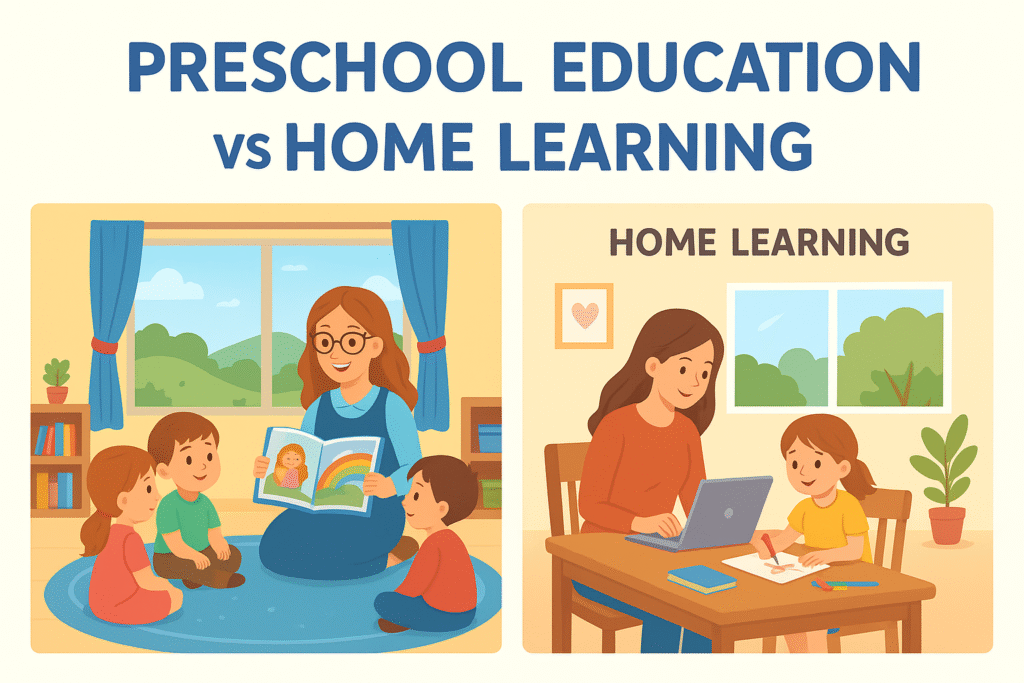
Preschool education refers to formal early childhood learning programs designed for children aged 2 to 5 years. These institutions provide structured learning through play, storytelling, music, and creative activities.
A strong preschool program focuses on a child’s holistic growth — cognitive, emotional, social, and physical. It helps children transition smoothly from home to formal schooling while developing essential life skills such as communication, problem-solving, and teamwork.
Key Features of Preschool Education
- Structured daily routine
- Play-based curriculum aligned with child development milestones
- Professional educators trained in early childhood teaching
- Exposure to group learning and social interaction
- Focus on emotional well-being, creativity, and curiosity
What Is Home Learning?
Home learning, often referred to as homeschooling or home-based early education, allows parents to teach their children at home instead of sending them to a preschool. It can include activities such as reading together, doing art and craft projects, learning through play, or using online educational tools.
In home learning, parents act as both caregivers and educators, guiding the child’s development based on their pace and interests. It’s flexible, personalized, and often less stressful for children who may take time to adapt to formal environments.
Key Features of Home Learning
- Flexible learning schedule
- One-on-one attention from parents
- Customizable lessons based on the child’s interests
- Safe, comfortable home environment
- Lower or no tuition costs
Benefits of Preschool Education
1. Social Development
Children in preschool education learn to share, cooperate, and communicate effectively. Interaction with peers and teachers builds confidence and emotional intelligence.
2. Early Literacy and Numeracy Skills
Preschools introduce children to letters, sounds, numbers, and colors through play-based activities. These foundations make learning in higher classes easier and more enjoyable.
3. Structured Routine and Discipline
A preschool education helps children adjust to schedules and routines, preparing them for school life. They learn to follow instructions, wait their turn, and manage transitions.
4. Trained Teachers and Expert Guidance
Preschool educators understand child psychology and employ teaching strategies that promote creativity, independence, and curiosity.
5. Exposure to Diversity
Preschools offer an environment where children experience diverse backgrounds and cultures, fostering open-mindedness and empathy.
Benefits of Home Learning
1. Personalized Learning
Home learning allows parents to tailor activities according to their child’s interests, pace, and developmental needs. Children can explore topics deeply without time constraints.
2. Flexible Environment
There’s no rigid schedule. Learning can happen anytime—during play, daily chores, or storytelling. This flexibility can reduce pressure and make learning more natural.
3. Stronger Parent-Child Bond
Parents play a central role in home learning, creating more opportunities for bonding and emotional security.
4. Focus on Safety and Comfort
The home environment feels familiar and safe. Parents can control what their child is exposed to and ensure comfort throughout learning sessions.
5. Cost-Effective Option
Home learning saves on tuition fees, uniforms, and transportation costs. It can be an affordable way to provide quality education with the right resources.
Challenges of Preschool Education
While preschool education offers structured learning, it also has some challenges:
- Less individual attention in larger classrooms
- Fixed schedules that may not suit every child
- Risk of early academic pressure if not balanced with play
Challenges of Home Learning
Home learning also comes with its own limitations:
- Requires high parental commitment and patience
- Limited exposure to social interactions
- Lack of professional teaching expertise
- May lead to over-dependence on parents
- Difficulty transitioning to formal school later
Comparing Preschool Education and Home Learning
| Aspect | Preschool Education | Home Learning |
| Learning Environment | Structured classrooms and group activities | Flexible, home-based, one-on-one |
| Social Interaction | Regular peer engagement | Limited unless arranged externally |
| Teacher Role | Professional early educators | Parents as teachers |
| Learning Style | Curriculum-based, guided by developmental milestones | Customized, interest-based |
| Routine | Fixed daily schedule | Flexible timing |
| Cost | Varies by school | Mostly minimal |
| Skill Development | Holistic: academic, emotional, social | Personalized, but may lack group dynamics |
Finding the Right Balance
There’s no universal answer to which method is best. Every child is unique. Some thrive in a structured preschool environment, while others blossom through flexible home learning.
Many parents today choose a hybrid model—combining preschool education with home activities. For example, a child might attend preschool in the morning and enjoy guided play or reading sessions at home later. This approach offers the best of both worlds: structured learning and personal attention.
How to Decide What’s Best for Your Child
When deciding between preschool education and home learning, consider these factors:
- Your child’s personality (social, shy, or independent)
- Your daily availability and teaching comfort level
- The quality of preschools in your area
- Your child’s developmental readiness for group settings
- Long-term educational goals
Visiting a few preschools, observing classes, and speaking with teachers can give you valuable insight. Similarly, trying short-term home learning can help you gauge your child’s response
Both preschool education and home learning aim to nurture young minds during their most impressionable years. The best choice depends on your child’s needs, your lifestyle, and the learning goals you envision.
A structured preschool education offers social interaction, expert guidance, and developmental balance, while home learning provides flexibility, comfort, and personalized growth.
Whichever path you choose, remember — learning should always be joyful, engaging, and filled with love. The goal isn’t just early education but building a lifelong passion for learning.