

How Preschool Helps Build Strong Social Skills in Kids
Social skills play an important role in a child’s overall development. The ability to communicate, cooperate, share, listen, make friends, and manage emotions helps children feel comfortable in different social situations. These skills also support learning, confidence, and healthy relationships as children grow.
Preschool provides young children with regular opportunities to interact with teachers and peers in a structured yet playful environment. Through group activities, stories, games, role-play, and everyday classroom experiences, children gradually learn how to understand others and respond appropriately.
For parents, understanding how early education supports social development can help them make informed decisions about their child’s learning journey.
Why Are Social Skills Important for Young Children?
Social skills help children participate positively in family, school, and community environments. Young children are still learning how to express their feelings, understand other people’s perspectives, and respond to social situations.
Strong social skills can help children:
- Communicate their thoughts and feelings
- Make and maintain friendships
- Share toys and learning materials
- Take turns during activities
- Listen when others are speaking
- Cooperate with classmates
- Handle disagreements appropriately
- Understand basic social boundaries
- Develop empathy and kindness
- Feel more confident in group situations
These abilities do not develop overnight. Children learn them through repeated interactions, guidance, observation, and practice.
How Preschool Encourages Social Interaction
A preschool classroom naturally creates opportunities for children to interact with others throughout the day. Instead of learning social behaviour only through instructions, children experience it during real activities and relationships.
For example, when children work together to complete a puzzle, they may need to share pieces, communicate ideas, listen to another child, and wait for their turn. A teacher can guide them when disagreements occur and demonstrate positive ways to communicate.
This everyday practice helps children understand that social interaction involves both expressing themselves and considering others.
1. Learning to Share and Take Turns
Sharing can be challenging for young children because they are still developing an understanding of cooperation and patience.
In preschool, children may encounter situations where they need to share:
- Toys
- Books
- Art supplies
- Building blocks
- Classroom equipment
- Games and activity materials
Teachers can encourage children to take turns and explain why waiting and sharing are important. With regular practice, children gradually become more comfortable with cooperative play.
Parents can reinforce the same behaviour at home by creating simple opportunities to share toys with siblings, friends, or family members.
2. Building Communication Skills
Good social relationships depend on effective communication. Children need opportunities to express what they want, ask questions, describe their experiences, and communicate their feelings.
Preschool activities such as storytelling, circle time, role-play, songs, and group conversations can encourage children to speak and listen.
Teachers can also introduce simple social phrases such as:
- “Can I play with you?”
- “Please give me a turn.”
- “Can you help me?”
- “I don’t like that.”
- “Thank you.”
- “I’m sorry.”
Learning these expressions gives children practical tools for everyday interactions.
3. Encouraging Cooperative Play
Play is one of the most natural ways for young children to develop social abilities.
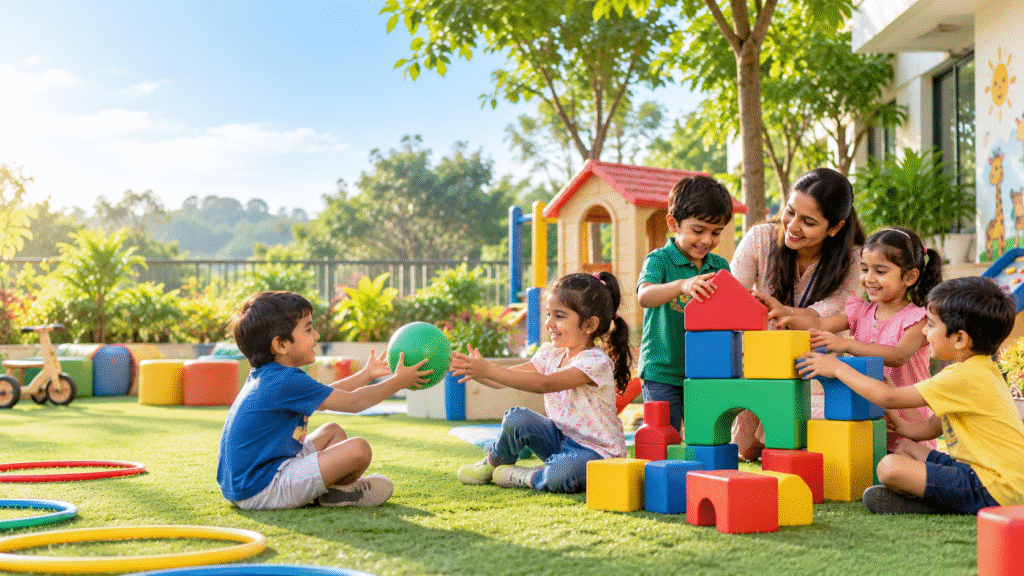
During cooperative activities, children may work together to build a structure, create artwork, act out a story, or participate in a group game.
A preschool that provides opportunities for cooperative play allows children to experience teamwork in an enjoyable setting.
They begin to understand concepts such as:
- Working toward a shared goal
- Listening to another person’s ideas
- Contributing to a group
- Helping classmates
- Accepting different approaches
- Celebrating others’ achievements
These experiences can become valuable foundations for future classroom and social situations.
4. Developing Empathy and Understanding
Empathy means beginning to recognise and respond to another person’s feelings. Young children gradually develop this ability as they observe emotions and learn how their actions affect others.
Teachers can encourage empathy through stories, discussions, role-play, and everyday classroom situations.
For example, if a child is upset, a teacher may ask the group:
“How do you think your friend is feeling?”
Questions like this encourage children to think beyond their own feelings and consider another person’s experience.
Stories can be particularly useful because children can explore different characters, emotions, and situations in a safe and engaging way.
5. Helping Children Manage Conflicts
Disagreements are a normal part of childhood. Two children may want the same toy, disagree about the rules of a game, or become frustrated when playing together.
Rather than expecting children to avoid every conflict, early education can teach them how to handle disagreements constructively.
Teachers can encourage children to:
- Explain what happened.
- Listen to the other child.
- Identify how each person feels.
- Think about possible solutions.
- Choose a fair way forward.
With guidance and practice, children gradually learn that problems can often be solved through communication rather than anger or physical reactions.
6. Building Confidence in Group Situations
Some children naturally enjoy speaking and participating in groups, while others may need more time to feel comfortable.
A supportive preschool environment can give quieter children opportunities to participate without forcing them into situations that feel overwhelming.
Simple activities such as introducing themselves, answering questions, showing artwork, singing a song, or sharing a favourite story can gradually build confidence.
Positive encouragement from teachers can help children understand that their ideas and contributions are valued.
7. Learning to Follow Social Rules
Children need to understand that different environments have different expectations.
Classroom routines introduce basic social rules such as:
- Listening when someone is speaking
- Waiting for a turn
- Walking safely indoors
- Keeping shared spaces organised
- Respecting other people’s belongings
- Using polite language
- Following group instructions
These rules help children understand how individual behaviour can affect an entire group.
8. Developing Friendships
Making friends is an important part of early childhood. Regular interaction with other children gives them opportunities to discover common interests and develop relationships.
In preschool, friendships may begin through shared interests such as drawing, building, pretend play, music, or outdoor games.
Children learn that friendship involves:
- Spending time together
- Listening to one another
- Helping each other
- Sharing experiences
- Respecting differences
- Solving small disagreements
These early relationships can help children develop a greater sense of belonging.
9. Learning Through Role-Play
Role-play allows children to practise social situations in a fun and safe way.
For example, children might pretend to be:
- Doctors and patients
- Shopkeepers and customers
- Teachers and students
- Parents and children
- Community helpers
During these activities, children practise conversation, cooperation, listening, turn-taking, and understanding different roles.
Role-play can also encourage creativity while giving children an opportunity to explore how people communicate and behave in different situations.
10. The Teacher’s Role in Social Development
Teachers play an important role in modelling positive social behaviour. Children often learn by observing how adults communicate, solve problems, listen, and respond to emotions.
A teacher can demonstrate:
- Respectful communication
- Patience
- Kindness
- Active listening
- Cooperation
- Problem-solving
- Emotional awareness
When teachers respond calmly to challenging situations, children can observe practical examples of positive behaviour.
How Parents Can Support Social Skills at Home
The development of social skills continues beyond the classroom. Parents can create everyday opportunities for children to practise what they learn.
Try activities such as:
- Arrange playtime with other children.
- Encourage children to share and take turns.
- Read stories about friendship and emotions.
- Ask children how another person might feel.
- Encourage them to express feelings using words.
- Play board or turn-based games together.
- Praise kind and helpful behaviour.
- Let children participate in simple household responsibilities.
- Teach respectful ways to disagree.
- Model polite communication at home.
Most importantly, give children time to practise. Social development happens gradually, and every child has their own personality and pace of development.
Choosing an Environment That Supports Social Development
When selecting a preschool, parents can look beyond academic activities and consider how the learning environment supports children’s relationships and emotional development.
Parents may want to observe:
- How teachers communicate with children
- Whether children have opportunities for group play
- How teachers handle disagreements
- Whether children are encouraged to express themselves
- Whether activities promote cooperation
- Whether the classroom feels welcoming and inclusive
- How teachers encourage kindness and respect
A nurturing environment can help children feel secure enough to participate, interact, and learn from their experiences.
Frequently Asked Questions
How does preschool improve social skills?
Preschool gives children regular opportunities to interact with peers and teachers through group activities, play, storytelling, role-play, and classroom routines. These experiences allow children to practise communication, cooperation, sharing, turn-taking, and emotional expression.
What social skills should children develop before primary school?
Children can gradually develop skills such as listening, communicating, taking turns, cooperating, making friends, expressing emotions, following simple rules, and asking for help.
Does play help children develop social skills?
Yes. Play provides natural opportunities for children to communicate, cooperate, negotiate, share, solve problems, and understand other people’s ideas and feelings.
How can parents encourage better social behaviour?
Parents can model respectful communication, encourage sharing and turn-taking, arrange opportunities for children to interact with peers, discuss emotions, and praise positive social behaviour.
Strong social skills provide children with an important foundation for learning and relationships. Through everyday interactions, children learn how to communicate, cooperate, understand emotions, solve disagreements, and participate confidently in groups.
A well-designed preschool experience can support this development by combining structured routines with play, group activities, meaningful conversations, and positive teacher guidance.
For parents, the goal should not be to expect perfect social behaviour from young children. Instead, it is to provide patient guidance and plenty of opportunities for children to practise these skills. With consistent support from home and school, children can gradually become more confident, cooperative, empathetic, and comfortable interacting with others.