

Nurturing the Whole Child: Building Social and Emotional Skills at Preschool
A child’s early years bring many new experiences, discoveries, and opportunities to learn. During this period, children begin to understand their emotions, communicate their needs, interact with others, and develop a sense of independence. Preschool can provide a supportive setting where these abilities grow through play, daily routines, creative experiences, and relationships with teachers and classmates.
Early education is about much more than recognising letters, counting numbers, or completing worksheets. A child’s overall growth also involves learning how to express feelings, build friendships, solve simple problems, and respond to different situations.
This is the idea behind nurturing the whole child. It focuses on supporting children’s emotional, social, physical, language, and thinking skills together. When these areas receive attention, children have more opportunities to develop confidence and prepare for future learning experiences.
What Is Whole-Child Development in Preschool?
Whole-child development recognises that children learn in different ways and progress at different rates. One child may enjoy speaking in a group, while another may prefer listening before joining a conversation. Some children quickly adapt to new surroundings, while others need reassurance and time.
A supportive preschool environment respects these differences and offers activities that encourage growth across several areas. nurturing the whole child
Key aspects of whole-child development include:
- Social growth: Learning to cooperate, communicate, respect others, and develop friendships.
- Emotional awareness: Identifying feelings and discovering appropriate ways to express them.
- Language skills: Listening carefully, sharing ideas, and communicating needs.
- Thinking abilities: Exploring new concepts, asking questions, and finding solutions to simple problems.
- Physical development: Improving balance, coordination, and fine motor skills through movement and hands-on tasks.
- Self-reliance: Gradually learning to make choices and manage simple everyday responsibilities.
These skills often develop together. For example, when children work on a group art project, they may practise communication, patience, decision-making, cooperation, and creativity in a single activity. nurturing the whole child
Why Social and Emotional Skills Matter During Early Childhood
Starting preschool introduces children to experiences beyond their familiar home environment. They learn to follow group routines, interact with unfamiliar people, share materials, and manage situations that may not always go as expected.
With appropriate adult support, these experiences can help children develop important social and emotional abilities.
1. Helping Children Understand Their Emotions
Young children can experience strong feelings but may not yet know how to describe them clearly. They might become upset when a toy is unavailable, feel nervous about joining a group, or become frustrated when a task seems difficult.
Teachers can help children recognise these feelings by using simple, reassuring language.
For instance, an educator might say, “You seem frustrated because the blocks keep falling.” This acknowledges the child’s experience and creates an opportunity to discuss what happened. nurturing the whole child
Picture books, puppets, drawing, and pretend play can also help children explore emotions in a comfortable setting.
The aim is not to make children feel happy all the time. Instead, they can gradually learn that every emotion is understandable and that different situations call for different responses. Nurturing the whole child
2. Encouraging Children to Communicate Clearly
Good communication helps children express their needs, explain their ideas, listen to others, and ask for assistance when necessary.
Preschool experiences such as story discussions, singing sessions, group conversations, and show-and-tell can provide regular opportunities to practise these skills.
Teachers can encourage participation by asking straightforward questions and giving children enough time to respond. They can also model respectful expressions such as “May I have a turn?” and “Can you please help me?” nurturing the whole child
With regular practice, children can become more comfortable expressing their thoughts and interacting with others.
3. Creating Opportunities for Friendship
Learning to build relationships is an important part of a child’s early social experience. At preschool, children can meet classmates with different interests, personalities, and ways of playing.
Shared activities can help them discover common interests and begin developing friendships.
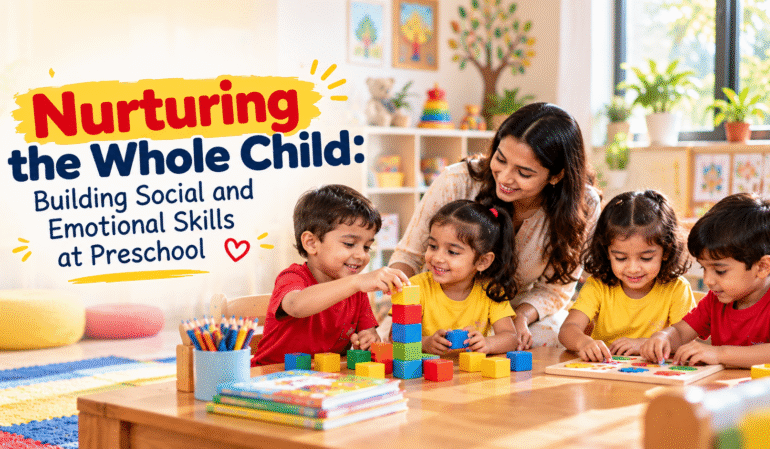
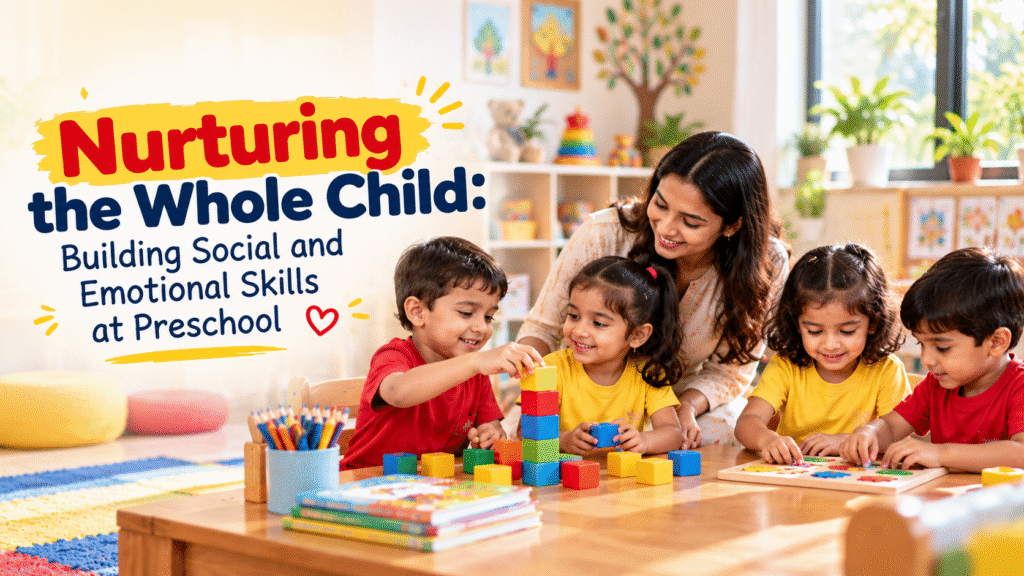
For example, children might build a tower together, complete a simple puzzle, or create a picture using shared art materials. These experiences encourage them to communicate, exchange ideas, and work towards a common goal. nurturing the whole child
Some children may take longer to approach their classmates. Rather than pressuring them to participate immediately, teachers can offer gentle encouragement and allow them to become familiar with the group at their own pace.
4. Teaching Patience and Turn-Taking
Waiting for a turn can be difficult when children are excited about a toy or activity. They are still learning how to manage their wishes while considering the needs of others.
Simple classroom games, shared play materials, and group activities give children opportunities to practise waiting and taking turns.
Teachers can make the process easier by explaining what will happen next and offering clear reminders. For example, children can take turns choosing a song or using a favourite set of building blocks.
When a child struggles, calm guidance can help them try again. These everyday experiences gradually introduce patience, fairness, and cooperation. nurturing the whole child
Preschool Activities That Encourage Overall Development
Children often develop important abilities while exploring, experimenting, and playing. Well-planned activities help children develop social and emotional skills naturally while keeping the learning experience fun and engaging. nurturing the whole child
1. Reading Stories and Discussing Characters
Picture books and short stories can introduce children to unfamiliar situations, relationships, and emotions.
After reading a story, teachers can invite children to think about the characters and their experiences. Questions might include:
- What might the character be feeling?
- What could the character try next?
- How could a friend help in this situation?
These conversations allow children to share ideas, listen to different viewpoints, and think about how actions affect others. nurturing the whole child
2. Pretend Play and Everyday Role-Play
Pretend play allows children to explore familiar situations through imagination. They might create a pretend shop, act out a visit to the doctor, or play the role of a teacher.
While taking on different roles, children can practise conversation, cooperation, decision-making, and problem-solving.
Teachers can join the activity when appropriate to demonstrate polite language, help children negotiate roles, or guide them through a disagreement. nurturing the whole child
3. Creative Expression Through Art and Craft
Art and craft activities give children an enjoyable way to share their imagination, thoughts, and experiences. Drawing, colouring, painting, and modelling with clay allow them to experiment with shapes, colours, and textures while developing hand control and attention.
Sometimes, children can express an idea through their artwork before they know how to describe it verbally. Teachers can encourage them to talk about their creations by asking simple, open-ended questions.
Focusing on a child’s creativity, effort, and personal ideas helps build confidence without making them feel that their work must look perfect. nurturing the whole child
4. Learning Through Music and Movement
Singing, dancing, action rhymes, and movement games make learning lively while helping children practise listening, remembering instructions, and coordinating their movements.
Taking part in group games helps children listen to instructions, pay attention to their peers, and learn to participate cooperatively.
Teachers should choose games that suit the children’s abilities and create opportunities for everyone to participate. The emphasis should be on enjoyment, cooperation, and participation rather than winning. nurturing the whole child
5. Developing Teamwork Through Building and Puzzles
Activities involving building blocks, matching games, puzzles, and sorting objects encourage children to explore ideas and solve simple challenges together.
For example, children can work as a team to build a tall tower or figure out where different puzzle pieces belong. When something does not work as expected, they have an opportunity to test new ideas, listen to suggestions, and share materials. nurturing the whole child
Teachers can encourage independent thinking by asking questions such as, “What could we do differently?” or “Can you think of a way to solve this together?”
These hands-on experiences help children practise teamwork, creative thinking, patience, and perseverance.
How Preschool Teachers Can Create a Supportive Emotional Environment
Children need to feel safe, respected, and accepted before they can comfortably explore new experiences. Preschool teachers can encourage emotional well-being by building trusting relationships and responding thoughtfully to children’s needs. nurturing the whole child
Build Positive Relationships With Children
Small interactions can make a meaningful difference in how children experience preschool. Greeting each child warmly, listening to their concerns, and responding with patience can help them feel noticed and valued.
When teachers remain approachable and dependable, children may become more comfortable expressing their thoughts, asking questions, and seeking assistance.
Teach Classroom Rules Through Everyday Practice
Clear expectations help children understand how to behave in a shared environment. Teachers can explain classroom expectations by modelling kind behaviour, showing children how to use toys properly, and reminding them to return materials after each activity. nurturing the whole child
Children may not remember every rule immediately. Repeating expectations calmly and showing them what to do helps make these lessons easier to understand.
Guide Children When Disagreements Occur
Children may disagree over toys, struggle to share materials, or become upset when another child has a different idea. These situations give children a chance to improve their communication skills and learn how to resolve problems. nurturing the whole child
Teachers can listen to both children, acknowledge their feelings, and help them consider a fair solution. They can also demonstrate useful phrases, such as “Can I use it after you?” or “Please help us take turns.”
Addressing behaviour respectfully allows children to understand the consequences of their actions without feeling embarrassed or excluded.
Adapt to Each Child’s Personality
Every child has their own interests, preferences, and comfort level. Some children enjoy speaking in front of a group, while others feel more confident during quiet play or one-to-one interactions.
Offering a variety of activities gives children different ways to participate. Teachers can encourage them to explore unfamiliar experiences gradually while respecting their individual needs. nurturing the whole child
How Parents Can Support Social and Emotional Growth at Home
Children continue learning important life skills through their interactions with family members. Simple daily experiences can help reinforce the lessons they encounter at preschool.
Help children talk about their feelings. Invite them to describe their experiences with questions such as, “What was the best part of your day?” or “How did you feel when you played with your friends?”
Encourage age-appropriate independence. Let your child choose a book, organise toys, or help prepare their school bag. These small responsibilities provide opportunities to practise decision-making and self-reliance.
Demonstrate kindness and respect. Children learn by observing how adults listen, communicate, apologise, and respond to frustration. Your everyday actions can provide valuable examples.
Create opportunities for social interaction. Family gatherings, supervised playdates, and outdoor games can help children practise communication, cooperation, and sharing. nurturing the whole child
Recognise positive behaviour. Appreciate your child’s attempts to help others, wait patiently, or work through a challenge. Specific encouragement can help them understand the importance of these actions.
Stay in touch with preschool teachers. Share observations about your child’s behaviour, interests, and adjustment. Regular communication can help families and educators identify useful ways to support development together.
How to Notice Your Child’s Social and Emotional Progress
Children develop new abilities gradually, and progress may look different from one child to another. Rather than expecting immediate changes, parents and teachers can pay attention to small improvements in everyday situations. nurturing the whole child
You may notice your child beginning to:
- Explain their needs and feelings more clearly.
- Ask for assistance when they face a challenge.
- Participate more comfortably in group activities.
- Practise waiting and taking turns with guidance.
- Respond thoughtfully when another child feels upset.
- Explore different solutions when an activity becomes difficult.
- Complete familiar tasks with increasing confidence.
These behaviours are examples of development, not strict milestones that every child must reach at the same time. If you have continuing concerns about your child’s emotional well-being, communication, or social interactions, discuss them with their teacher and seek advice from a qualified child-development professional when appropriate. nurturing the whole child
Common Mistakes to Avoid When Supporting Young Children
Helping children develop new skills takes time, patience, and realistic expectations. Certain approaches may make children feel pressured instead of supported.
- Comparing children with others: Every child has individual strengths, interests, and developmental needs.
- Expecting too much independence too soon: Children may need demonstrations, encouragement, and repeated practice.
- Dismissing uncomfortable emotions: Give children space to express sadness, frustration, and fear in appropriate ways.
- Rushing social participation: Allow children to observe and become comfortable before expecting them to join a group.
- Measuring progress only through academics: Social relationships, emotional awareness, physical activity, and creativity also contribute to early learning.
Providing encouragement and recognising gradual improvement can help children approach new experiences with greater confidence.
Frequently Asked Questions
1. What is whole-child development in preschool?
Whole-child development focuses on nurturing children’s social, emotional, physical, language, and thinking abilities alongside their early academic learning. It considers how these different areas contribute to overall growth.
2. Why should preschoolers develop social and emotional skills?
These abilities help children communicate their needs, build relationships, respond to everyday challenges, cooperate with classmates, and gradually develop independence.
3. Which preschool activities encourage emotional awareness?
Storybooks, pretend play, creative art, emotion cards, and guided conversations can introduce children to different feelings and help them explore appropriate ways to express themselves.
4. What can parents do to improve their child’s social skills?
Parents can model respectful communication, provide opportunities to play with other children, encourage turn-taking, and help their child work through disagreements calmly.
5. Do children develop social confidence at different rates?
Yes. Personality, previous experiences, and individual developmental needs can influence how children interact with others. Some become comfortable quickly, while others need additional time and support. Parents who have ongoing concerns can speak with the child’s teacher or a qualified professional.
Preschool offers children opportunities to develop abilities that extend beyond classroom lessons. Learning to express feelings, communicate respectfully, cooperate with classmates, and handle everyday responsibilities can all contribute to their overall development.
Through art, music, storytelling, group play, and supportive relationships, educators can create experiences that encourage children to explore, connect with others, and grow in confidence.
When parents and teachers work together, children benefit from consistent encouragement at school and at home. By respecting each child’s pace and celebrating small achievements, adults can help build a strong foundation for future learning, positive relationships, and emotional well-being.